
Custom Earring Cards for Studs, Hoops and Hooks
Paired holes · Hook cut-outs · 300–350gsm board · Foil logo · MOQ 1,000 pcs
An earring card is a small printed paperboard card with paired holes, slits or notches that hold a pair of earrings so they hang level on a retail rack and stay put in transit. It is the smallest and most unforgiving jewelry display card: if the holes are 1 mm off, the pair hangs crooked. We cut both holes in one die pass with ±0.5 mm tolerance, size the board to the earring weight, and print the card to match the box it ships in.
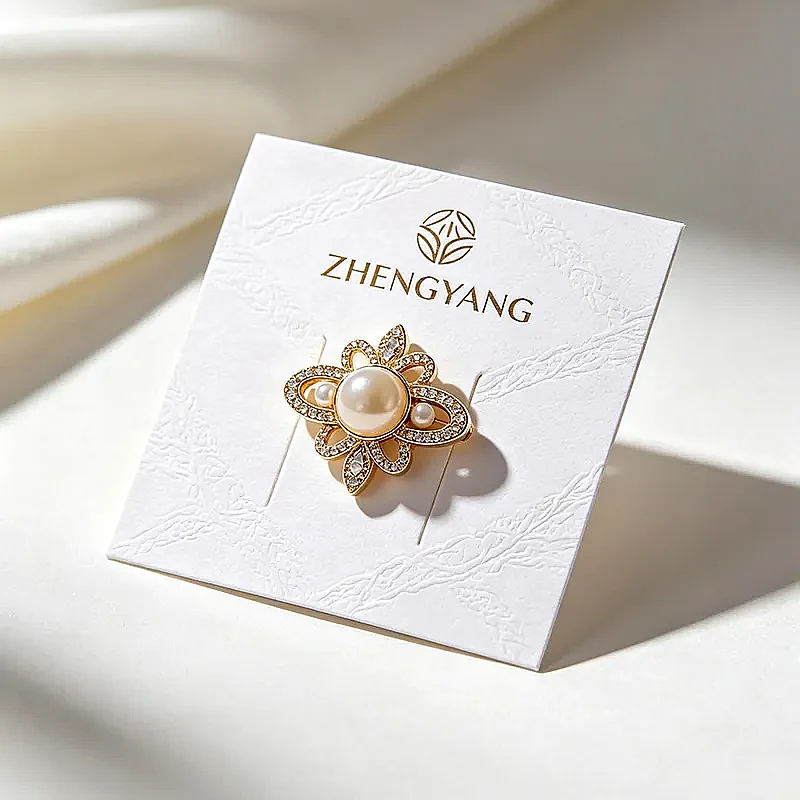
Earring Card Formats We Cut

Stud Pair Cards
Two holes on a shared centre line, spaced to the earring post gauge, with the pair sitting level on the peg.
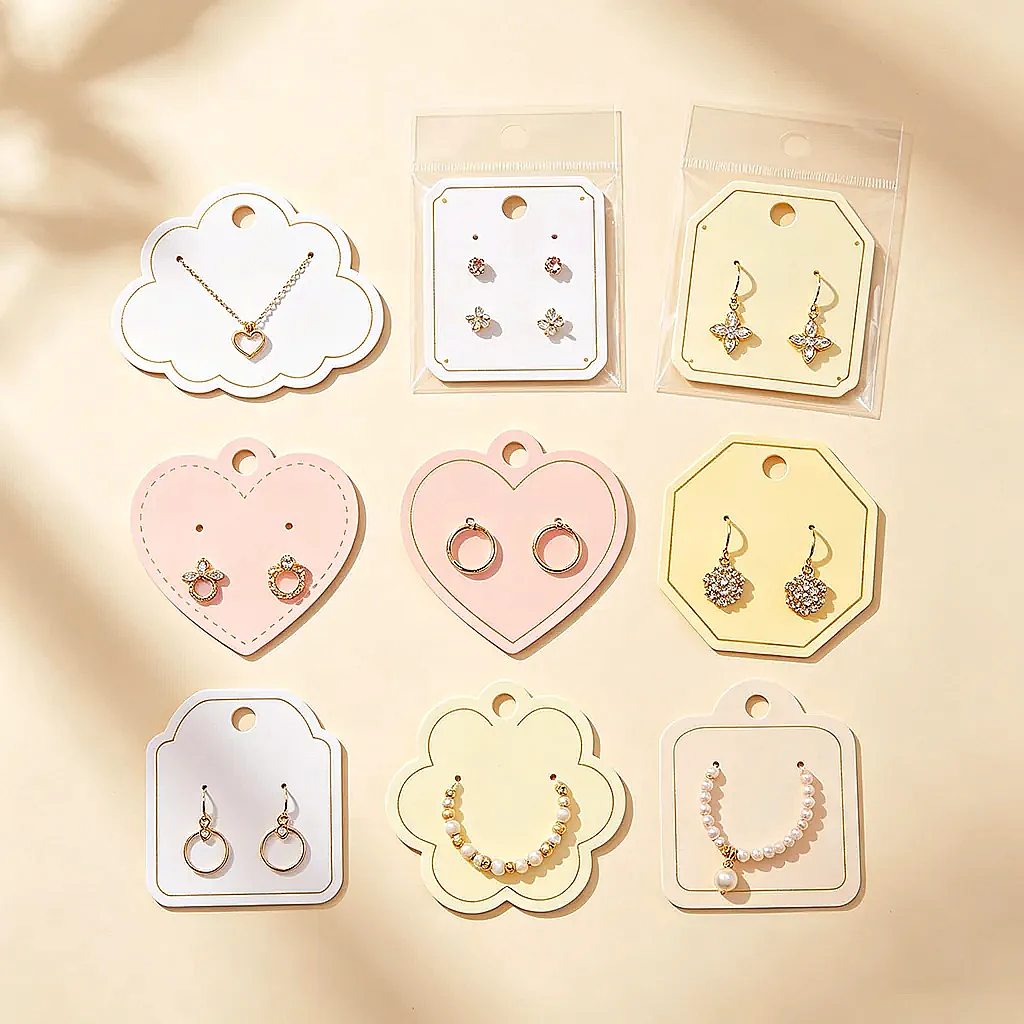
French Hook & Wire Cards
Vertical slits or keyhole cut-outs that grip the hook wire, so a drop earring hangs straight instead of sliding sideways.

Hoop & Huggie Cards
Wide slots or shaped notches for rigid hoops, sized to the hoop diameter so the earring sits in the card rather than hanging off it.

Velvet & Foil Earring Cards
Velvet-laminated or foil-stamped cards for premium earring lines, cut through the lining so the post passes cleanly.
What Decides Whether an Earring Card Looks Right
Both Holes in One Pass
Cutting the pair in a single die pass, to ±0.5 mm, is what keeps earrings level. Two separate operations are what make pairs hang crooked.
Post Gauge, Not a Generic Hole
Posts, hooks and hoops need different openings. We cut to the actual wire or post diameter so the earring is held, not merely threaded.
Board Weight Matched to the Piece
A 2 g stud needs 300gsm; a chunky hoop pulls harder and gets 350gsm. Oversized board on a light earring looks empty, undersized board curls.
Card Area Big Enough for Retail
Rack space is fixed, so card dimensions are set to the fixture first and the artwork is laid out around the holes, not the other way round.
Earring Cards Shipped Flat and Banded
Small cards ship flat in banded bundles, which keeps freight low even for large quantities. FOB, CIF or DDP door-to-door to 30+ countries, with the die kept on file for reorders.
Why Earring Cards Fail in Small Ways
An earring card is judged in a second: either the pair hangs level or it does not. The usual cause of a crooked pair is not design but process — holes punched in two operations, or a die that has drifted between runs. Cutting both holes in one pass, and checking the first sheet rather than the last, removes that failure mode.
The second common failure is a card that is too thick or too thin for the piece. A heavy hoop on 300gsm board curls forward on the peg within weeks; a small stud on 400gsm board looks lost in empty space and costs more than it needs to.
Holes, Slits and Cut-Outs by Earring Type
Stud earrings need two round holes at the post gauge, with the earring back captured behind the card. French hooks need a vertical slit or keyhole: the wire drops in from above, so the earring can be fitted without removing the back. Hoops need a slot or a shaped notch wide enough for the hoop section, otherwise the earring rotates and the card creases at the contact point.
Where a card is also a retail peg item, the peg hole is cut in the same pass as the earring holes. That single setup is what keeps the pair centred under the hanger instead of drifting to one side as quantities grow.
Printing, Foil and Velvet on Small Cards
Small cards are printed on the same offset line as boxes, which matters because the card sits next to the box on the shelf. ΔE≤2 batch control keeps the two from drifting apart between orders. A common layout is brand logo and size on the face, care or material notes on the reverse.
Hot foil and embossing are popular for earring cards because the card area is small and a single foil mark carries the brand. On velvet-laminated stock, the same foil reads softer and lower contrast, so we usually steer velvet cards towards deboss or a printed metallic instead.
Packing, MOQ and Export Handling
Cards are banded in 50s and packed flat, so a packing line can pick a bundle without counting. Cards that leave the factory flat also survive air freight without the corner curl you get from pre-hung jewelry.
Minimum order is 1,000 pieces per design and die. Samples take 3–5 working days on standard board, up to 8 with velvet or foil; production runs 7–15 working days. FSC CoC C018715, Sedex SMETA, RoHS and CE documentation is available with the shipment.
Getting an Earring Card Made
Send the Earring Type
Stud, hook, hoop or huggie, plus the post or wire diameter and the earring weight. A photo with a reference size is enough to start.
Approve Hole Layout
We send a dieline showing hole spacing, peg hole and card dimensions. Nothing is cut until the layout is approved.
Sample the Pair
3–5 working days on standard board, up to 8 with velvet or foil. The sample is fitted with your earring, not a stand-in.
Produce and Ship
7–15 working days production, IQC/IPQC/FQC inspection, banded flat and shipped FOB, CIF or DDP.
Earring Card Production Standards
| Item | Standard |
|---|---|
| Board | 300gsm for light studs · 350gsm for hoops and heavier pieces |
| Hole type | Paired round holes, vertical slit, keyhole or shaped notch |
| Minimum order | 1,000 pcs per design and die |
| Sampling | 3–5 working days · up to 8 with velvet, foil or embossing |
| Sample cost | $20–50, credited back on order confirmation |
| Production | 7–15 working days depending on quantity and finish |
| Colour accuracy | ΔE ≤ 2 per batch against the signed proof |
| Hole tolerance | ± 0.5 mm on hole diameter, spacing and peg-hole position |
| Finishing | Hot foil, deboss, spot UV or velvet lamination |
| Packing | Banded flat in 50s, export cartons |
| Shipping terms | FOB / CIF / DDP door-to-door to 30+ countries |
| Certifications | FSC CoC C018715 · Sedex SMETA · RoHS · CE |
Compliance Documents With Every Batch
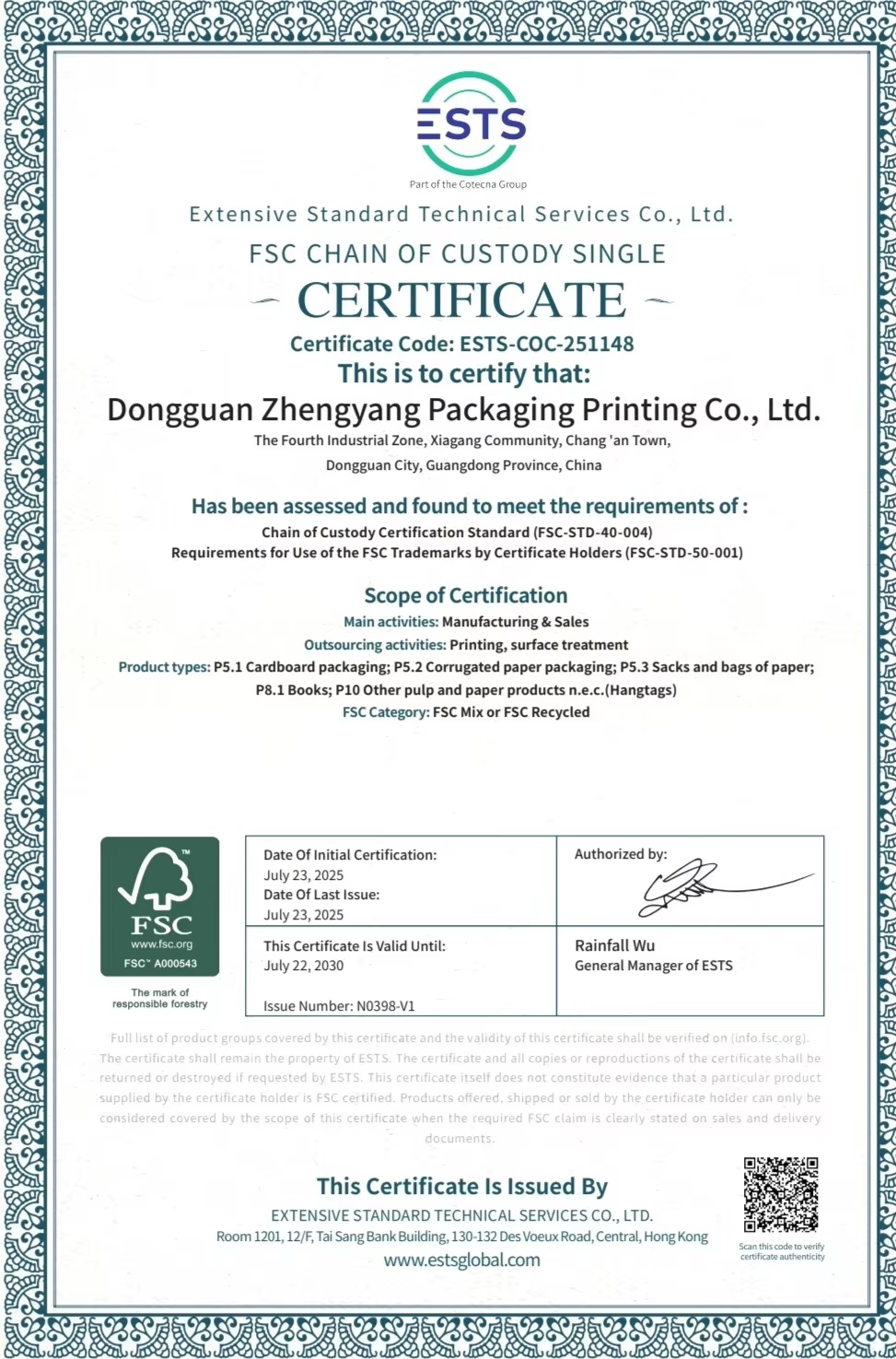
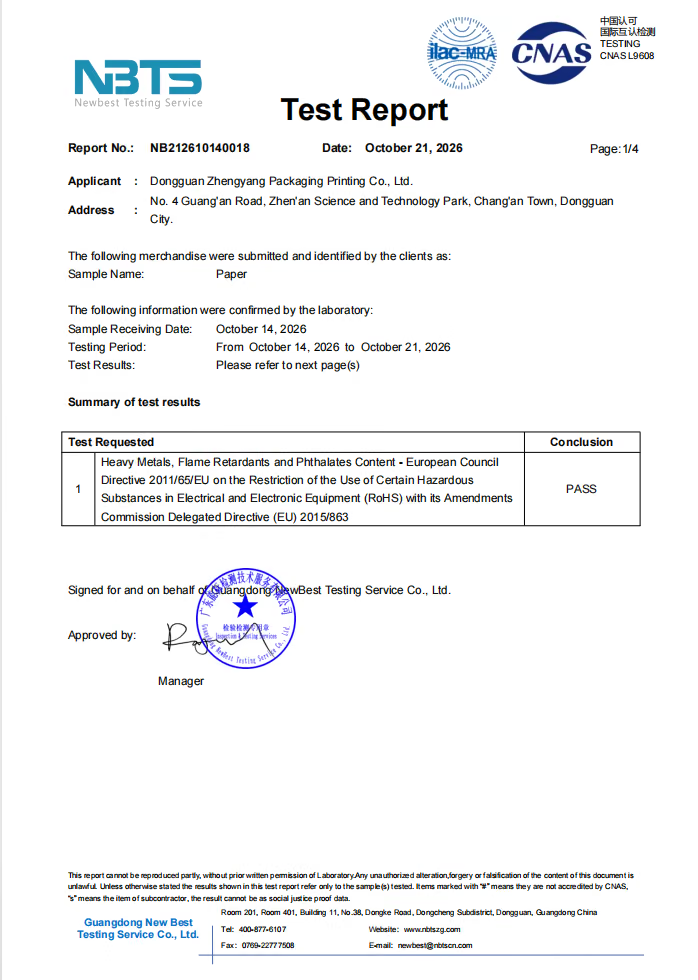
Earring cards are handled by retail staff and customers, so material documentation matters more than for shipping cartons. FSC CoC C018715 covers the board, and Sedex SMETA, RoHS and CE records are supplied with the order.
Earring Card Questions from Buyers
What is an earring card?
An earring card is a small printed paperboard card, usually 300–350gsm, with paired holes, vertical slits or shaped notches that hold a pair of earrings. It is one form of jewelry display card: earring cards hold studs, hoops and hooks, while necklace cards anchor a chain and ring cards hold a band.
Do you supply custom printed earring cards wholesale?
Yes. We manufacture earring cards for jewelry brands, retail chains, import distributors and e-commerce sellers, starting at 1,000 pcs per design. Bulk reorders reuse the same die, so scaling from 1,000 pcs to tens of thousands does not add tooling cost.
Can you print our logo on earring cards?
Yes — CMYK offset plus Pantone, and hot foil, deboss or spot UV where the card area allows. Earring cards are small, so a single foil mark often carries the brand better than a full printed panel; we will show both routes on the proof.
Are these hanging earring cards for retail racks?
Yes. The peg hole is cut in the same die pass as the earring holes, so the pair stays centred under the hanger at any quantity. Standard peg holes, euro slots and shelf notches are all available, and the same card can be banded flat for e-commerce parcels.
What is the minimum order for custom earring cards?
1,000 pieces per design and die. Because the card is small, the die and plate cost dominates a very small order, so 1,000 pcs is where the unit price becomes sensible; larger runs share the same tooling.
Which board weight suits my earrings?
Light studs are fine on 300gsm. Hoops, huggies and heavier pieces go to 350gsm because the card has to resist the earring pulling forward on a peg. Velvet lamination adds thickness and stiffness on top of the board weight.
Can the card hold earrings during shipping?
Yes, provided the opening matches the post or hook. We cut to the actual wire diameter so the earring is gripped rather than loosely threaded, and the pair is banded flat so nothing swings inside the carton.
Do you cut the peg hole at the same time as the earring holes?
Yes — peg hole, earring holes and any fold line are cut in one pass. Separate operations are what cause a pair to sit off-centre under the hanger, so we avoid them by design.
Can I order cards that match my jewelry boxes?
Yes. Cards and boxes run on the same offset line with ΔE≤2 colour control, and we keep both dielines on file so a reorder of one matches the other even months later.
How fast can earring cards be delivered?
Sampling takes 3–5 working days, up to 8 with velvet or foil. Production runs 7–15 working days, then shipping: about 5–8 days by air or 25–35 days by sea under FOB, CIF or DDP terms.
Send One Earring, Get a Card That Fits
Tell us the earring type, post or wire diameter and target quantity. We reply with a hole layout, board recommendation and itemised quote.