
Custom Necklace Cards That Hold a Chain Still
Drape slots · Arch windows · 350–400gsm board · Velvet backing · MOQ 1,000 pcs
A necklace card is a printed paperboard card with two anchor slots that hold a chain in a fixed arc, so the necklace hangs the way you designed it instead of tangling in the box. We cut the drape slot to your chain and length, stiffen the board to 350–400gsm so it does not bow on the peg, and print card and jewelry box together so the two match under retail light.
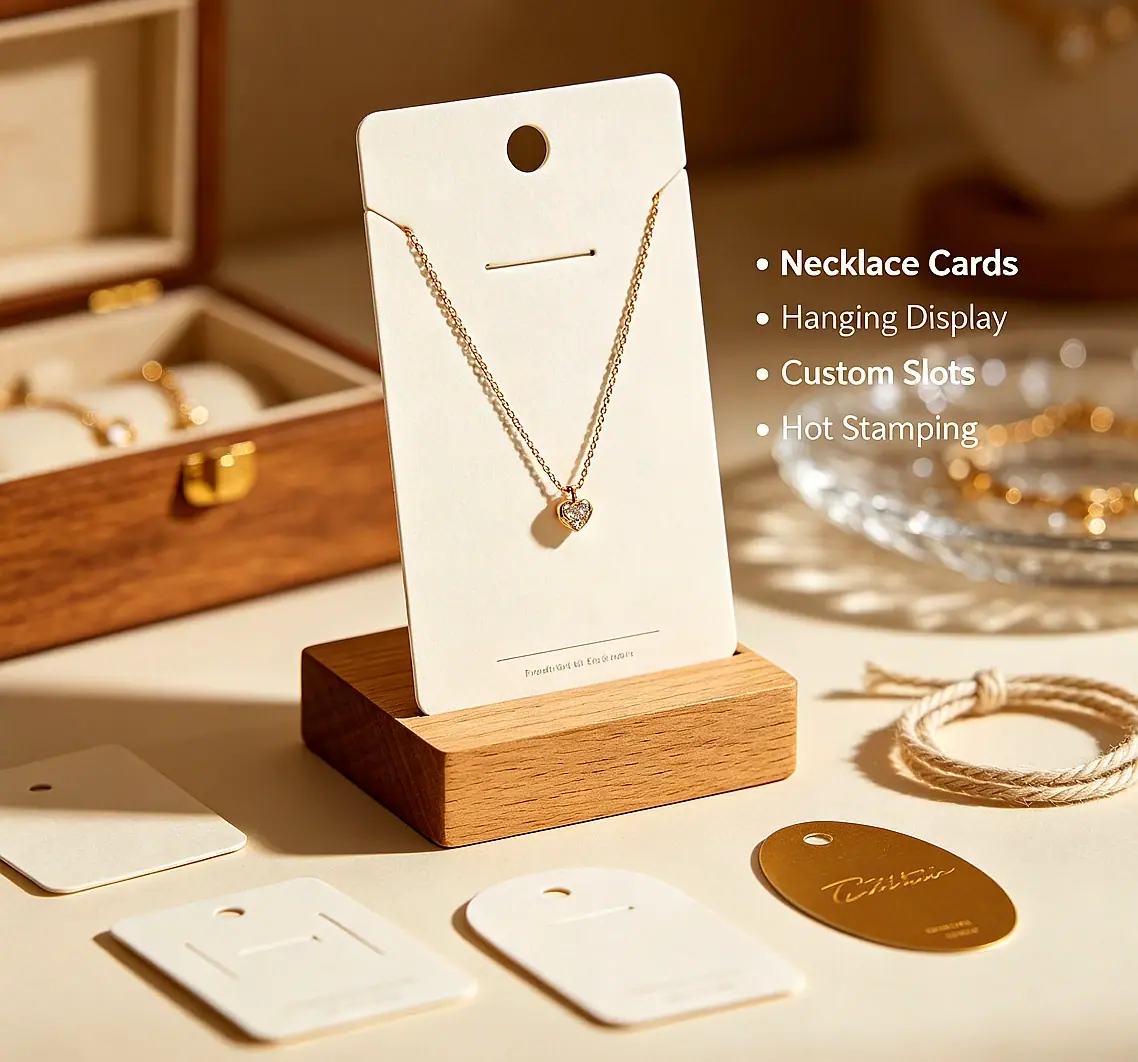
Necklace and Bracelet Card Styles

Two-Slot Drape Cards
Chain anchored at both ends so the necklace hangs in a fixed arc instead of swinging loose in the box or on the peg.

Arch-Window Cards
A cut window frames the pendant while the chain runs behind the board, so the focal piece sits forward and the clasp is hidden.

Bracelet & Anklet Cards
Shorter cards with side slots for rigid bangles and chain bracelets, sized to the wrist loop so the piece does not rotate.

Fold-and-Mail Cards
One piece of board with a fold line and lock tab: display it standing, then fold flat and post it without unclipping the necklace.
Why the Slot Geometry Decides the Card
Slot Width Matches the Chain
A 1 mm cable chain and a 3 mm curb chain need different slits. We cut to ±0.5 mm and test the actual chain, not a proxy.
Board Stiffness Follows the Drop
The longer the necklace, the more torque it applies to a hanging card. We move from 350gsm to 400gsm as the drop and chain weight increase.
Grain Direction Stops Bowing
Board grain is run along the hanging direction so a card on a peg stays flat through a season instead of curving forward.
One Die for Retail and Mail
Peg hole, fold line and lock tab are cut in the same pass, so the store version and the mailer version come from one tool.
Necklace Cards Shipped Flat
Cards are banded flat and packed in export cartons, so you pay for board volume rather than air. We ship FOB, CIF or DDP door-to-door to 30+ countries and keep the die on file for reorders.
Why a Necklace Card Is Not Just a Printed Rectangle
A necklace is the hardest jewelry category to card because the piece is long, flexible and heavy at the clasp. If the card only has one hole, the chain hangs from a single point, swings during transit and arrives knotted. The fix is geometric: two anchor points, set at the width you want the necklace to hang, turn a loose chain into a fixed arc.
That arc then constrains everything else. The card must be tall enough that the lowest point of the necklace clears the bottom edge by a comfortable margin, and wide enough that the arc does not pull the anchors inward. Both numbers come from the jewelry, so we ask for the chain length and pendant drop before drawing the dieline.
Slot Types and What Each One Is For
Three slot families cover most necklace work. Straight slits are the cheapest and suit uniform cable chains. Keyhole slots — a round entry narrowing into a slit — let the chain drop in from the front without threading, which speeds up packing lines. Arched slots follow the natural curve of a chain, so the necklace keeps a soft drape instead of a hard V.
For pendants, we cut a window or arch in the board and run the chain behind it. The pendant then sits proud of the card face rather than pressed into it, which protects the stone and photographs better in e-commerce listings. The window edge is checked on the first sheet for delamination, particularly on velvet-laminated stock.
Velvet, Foil and the Finish Around the Chain
A velvet-backed card reads as premium, but it changes how the card behaves. Lamination adds thickness and stiffness, so a 350gsm board becomes closer to 400gsm in feel; the slot must be cut sharper and slower to avoid a frayed edge. Foil on velvet gives a soft, low-contrast mark, so a deboss or a printed metallic often looks cleaner for a logo.
Ink coverage matters too. Heavy solid ink directly beside a slot makes the board brittle at the cut, and the slit can crack after a few packings. We keep clear space around the slot and, where the design allows, move the heavy coverage to the lower half of the card.
Retail Fixture or Mailer: Designing for Both
Necklaces are sold from a peg, a counter tray and a parcel — often the same SKU. Instead of three cards, we design one board with a peg hole at the top, a fold line across the middle and a lock tab at the bottom. Standing, the fold becomes a base; flat, the card slides into a mailer with the necklace still anchored.
That approach also cuts freight. Cards ship flat and banded, and the same die is reused on reorders without new tooling. Production runs 7–15 working days after a 3–5 day sample, with velvet or foil versions taking up to 8 days at the sample stage.
How a Necklace Card Order Runs
Send Chain and Pendant Details
Chain length, link type, pendant drop and the display format (peg, tray or mailer). We draw the dieline around those numbers.
Approve Slot Layout
You approve anchor spacing, slot type, window position and peg-hole placement before a die is made.
Sample on Final Board
3–5 working days, or up to 8 with velvet lamination, foil or embossing. The sample uses the production board and finish.
Produce, Inspect, Ship
7–15 working days under IQC/IPQC/FQC inspection, banded flat, shipped FOB, CIF or DDP.
Necklace Card Production Standards
| Item | Standard |
|---|---|
| Board | 350gsm standard · 400gsm for long drops and heavier chains |
| Slot type | Straight slit, keyhole slot or arched drape slot, cut to chain diameter |
| Pendant window | Arch or shaped window, chain routed behind the board |
| Minimum order | 1,000 pcs per design and die |
| Sampling | 3–5 working days · up to 8 with velvet, foil or embossing |
| Production | 7–15 working days depending on quantity and finish |
| Colour accuracy | ΔE ≤ 2 per batch against the signed proof |
| Die-cut tolerance | ± 0.5 mm on card size, slot width and anchor spacing |
| Retail hardware | Peg hole, euro slot or shelf notch cut in the same die pass |
| Packing | Banded flat in 50s, export cartons |
| Shipping terms | FOB / CIF / DDP door-to-door to 30+ countries |
| Certifications | FSC CoC C018715 · Sedex SMETA · RoHS · CE |
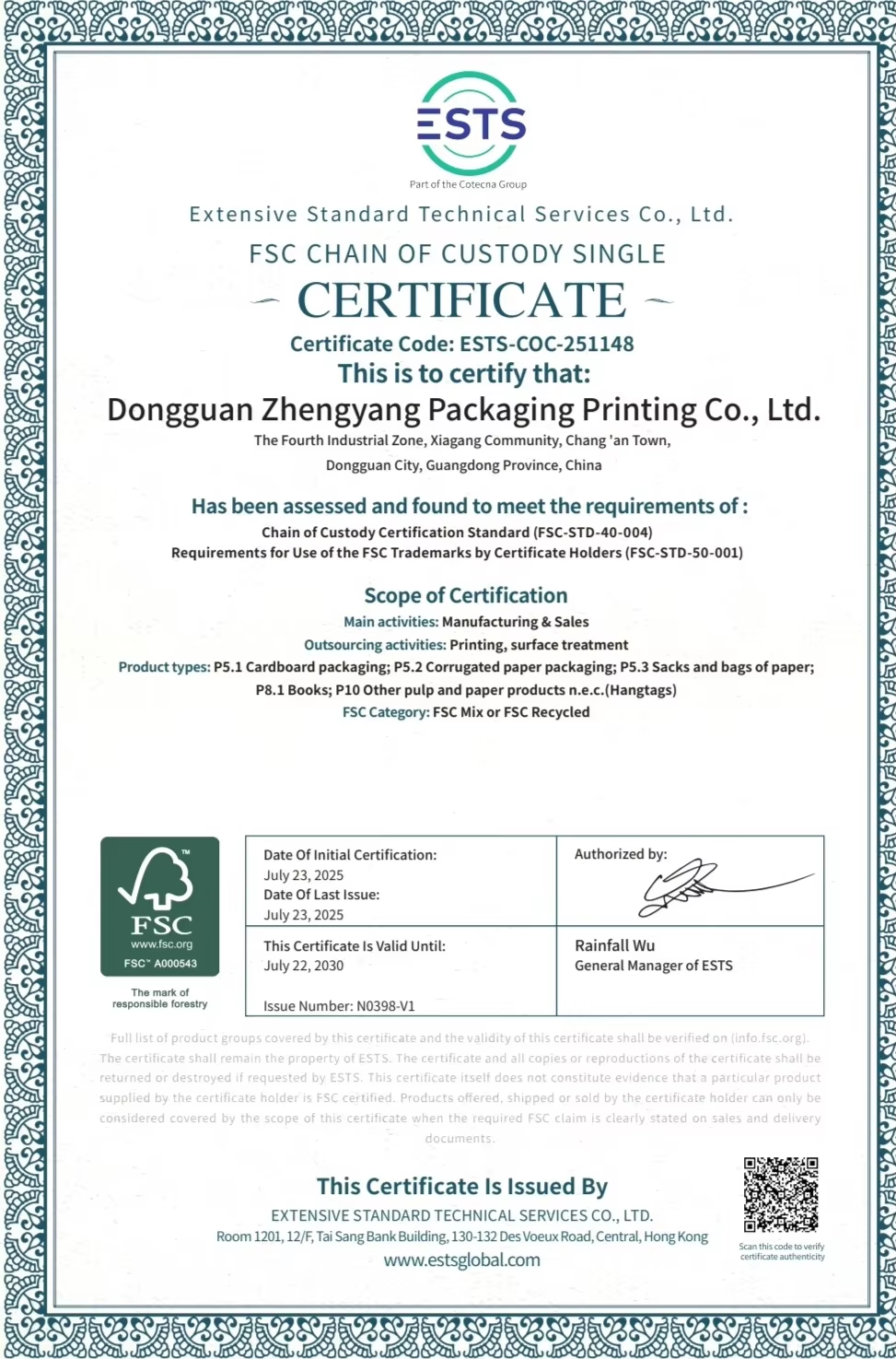
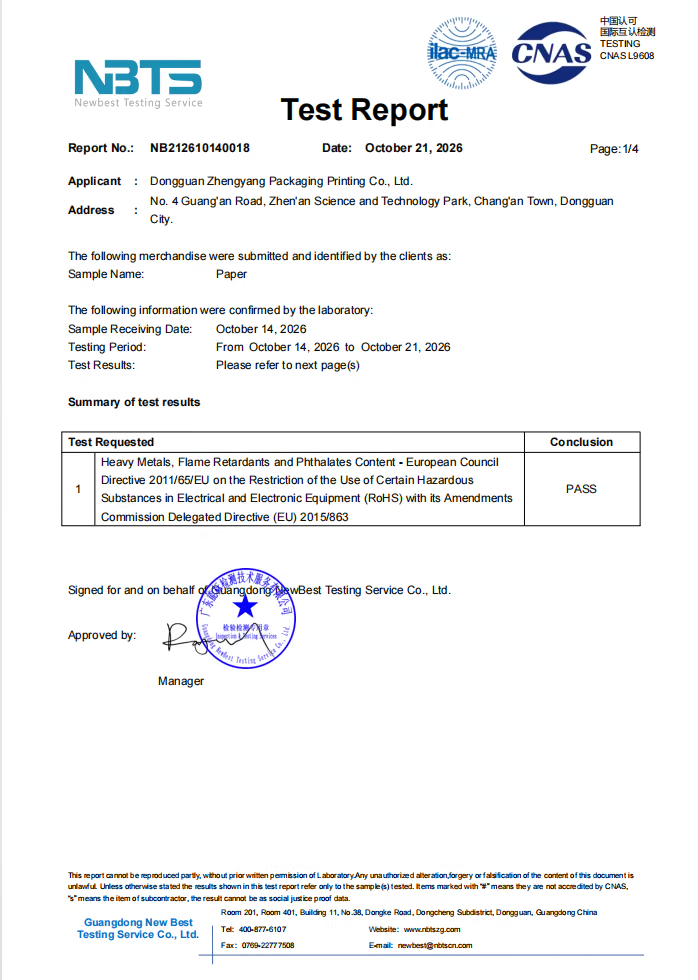
Documented Paper Chain of Custody
Necklace cards are often the piece a customer keeps, so the paper claim has to hold up. FSC CoC C018715 covers the board supply, and Sedex SMETA, RoHS and CE documents ship with the order for retailer compliance files.
Necklace Card Questions from Buyers
What is a necklace card?
A necklace card is a printed paperboard card, usually 350–400gsm, with two slots that anchor a chain at a set width so the necklace hangs in a fixed arc. It replaces a single-hole card, where the chain swings and tangles in transit, and it doubles as retail display and shipping packaging.
Do you make custom printed necklace cards in bulk or wholesale?
Yes. We are a jewelry display card manufacturer supplying necklace and bracelet cards to brands, retail chains, import distributors and e-commerce sellers. Orders start at 1,000 pcs per design, and wholesale reorders reuse the same die, so there is no new tooling cost when you scale from a trial run to regular supply.
Can you print our logo on necklace cards?
Yes — CMYK offset plus Pantone, with foil, deboss or spot UV. Cards are printed on the same line as your jewelry boxes with ΔE≤2 colour control, which is why buyers order both together: the card and box then match under retail lighting.
How do I know which slot position to choose?
Send the chain length and pendant drop. We draw two or three anchor spacings on the dieline, and the sample shows how each arc sits when the necklace is fitted. Choosing on a sample is faster than calculating it from an artwork.
Will the chain tangle in transit?
Not if the necklace is anchored at two points and the card is banded flat. Single-hole cards are what allow tangling; two anchors plus a card wide enough for the arc keep the chain in one plane inside the mailer.
What board weight do you recommend for long necklaces?
350gsm works for most 40–50 cm chains. For longer drops, heavier chains or velvet-laminated cards we move to 400gsm, because the hanging piece applies leverage on the peg and lighter board curves forward over a season.
Can a pendant window be cut without hurting the card strength?
Yes, if the window is kept clear of the peg hole and the anchors. We route the chain behind the board so the pendant sits forward, and check the window edge for delamination on the first sheet, especially on laminated stock.
Do you print the matching jewelry box as well?
Yes. Card and box are printed on the same offset line with ΔE≤2 colour control, which is why buyers usually order them together — the two pieces then match under retail lighting instead of drifting apart between suppliers.
What is the lead time and minimum order?
Minimum order is 1,000 pieces per design and die. Samples take 3–5 working days, up to 8 with velvet or foil, and production runs 7–15 working days before FOB, CIF or DDP shipping.
Get a Dieline for Your Necklace
Send the chain length, pendant drop and target quantity. We reply with a slot layout, board recommendation and itemised quote, usually within one working day.